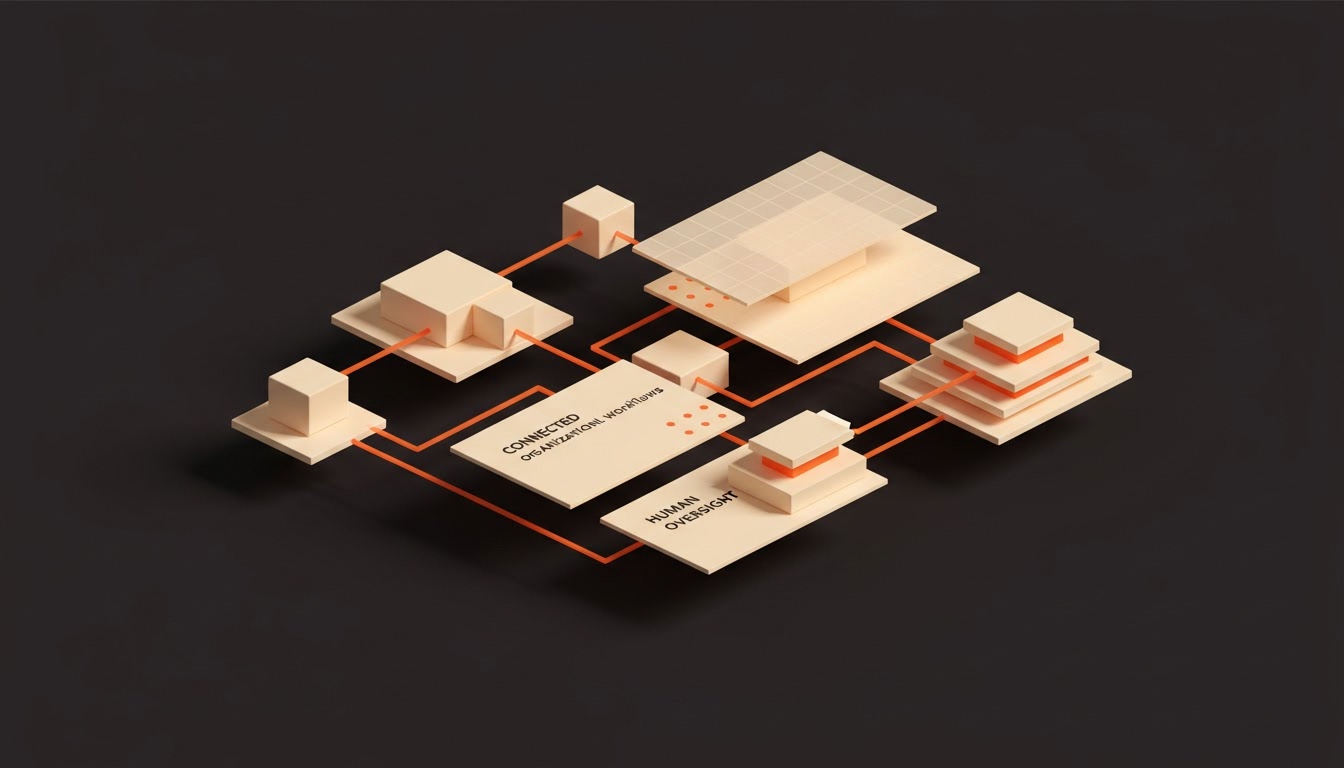
Integrating managed AI agents into operational workflows offers significant potential for enhanced throughput and service quality. However, operations leaders often face the critical challenge of adopting these powerful tools without ceding control or compromising the reliability and trustworthiness of their processes. The key lies in establishing a robust governance framework.
This article provides a pragmatic, source-backed operating guide for building trust in AI agents. We will explore how to implement governance that ensures accountability, transparency, and human oversight, enabling organizations to leverage AI's benefits while maintaining steadfast operational control and mitigating potential risks effectively.
Prioritizing Human Oversight in AI Agent Deployment
Operational control is maintained by embedding human oversight directly into AI agent workflows, ensuring that critical decisions and exceptions always route to human review. This prevents fully autonomous systems from operating unchecked, aligning with the OECD AI Principles' emphasis on human-centred values and accountability [2]. Organizations must define clear thresholds for human intervention.
A robust governance framework starts with mapping existing workflows to identify where AI agents can add capacity without compromising reliability. This involves assessing potential impacts and designing specific human review boundaries for each agent's task. The goal is to augment operational capacity, not to abdicate control, ensuring human accountability remains central.
- Define clear human review triggers.
- Establish accountability for AI agent outputs.
- Integrate human-in-the-loop mechanisms.
- Map existing workflows for AI agent integration.
Conducting Comprehensive AI Agent Impact Assessments
To avoid losing operational control, organizations must conduct thorough impact assessments before deploying AI agents, categorizing risks to inform governance. This approach, similar to the Government of Canada's Directive on Automated Decision-Making for federal systems [3], helps identify potential failure modes and their consequences. It ensures that safeguards are proportionate to the risk level.
A systematic assessment involves evaluating data quality, potential biases, and the criticality of the tasks assigned to AI agents. This diagnostic step allows operations leaders to proactively design controls, such as enhanced human review for high-impact decisions or stricter data validation protocols. It prevents unforeseen operational disruptions and maintains service quality.
- Categorize AI agent tasks by risk level.
- Assess data quality and potential biases.
- Identify potential failure modes.
- Design proportionate control mechanisms.
Operationalizing Human Review and Failure Mode Protocols
Maintaining operational control requires precise definition of human review boundaries, specifying when and why an AI agent's output requires human validation. This includes establishing protocols for handling ambiguous cases, unexpected results, or deviations from expected performance. Clear boundaries prevent AI agents from operating outside their intended scope.
Organizations must also anticipate and plan for failure modes, such as data quality issues, model drift, or integration errors. Developing clear escalation paths and fallback procedures ensures that operations can continue smoothly even when an AI agent encounters an issue. This proactive approach minimizes downtime and preserves service reliability.
- Define specific human validation points.
- Establish protocols for ambiguous or unexpected outputs.
- Develop clear escalation paths for AI agent failures.
- Implement fallback procedures for operational continuity.
Implementing Continuous Monitoring and Auditability
Sustained operational control over AI agents necessitates continuous monitoring of their performance, outputs, and adherence to defined parameters. This involves tracking key performance indicators, detecting anomalies, and ensuring the agent operates within its intended scope. Regular monitoring is crucial for identifying and addressing issues before they impact operations.
Auditability is equally vital, providing a transparent record of AI agent decisions and human interventions. This allows for post-incident analysis, compliance checks, and ongoing improvement of the system. Implementing robust logging and reporting mechanisms supports accountability and builds trust in the managed AI agents' operational integrity.
- Track AI agent performance and output KPIs.
- Detect anomalies and deviations from expected behaviour.
- Implement comprehensive logging of agent actions.
- Ensure audit trails support post-incident analysis.
Leveraging Frameworks for Trustworthy AI Governance
Operations leaders can effectively apply governance without losing control by leveraging established frameworks like the NIST AI Risk Management Framework (AI RMF) [1]. This voluntary framework provides a structured approach to incorporating trustworthiness considerations into the design, development, use, and evaluation of AI systems, guiding organizations through its GOVERN, MAP, MEASURE, and MANAGE functions.
While public-sector guidance, such as the Government of Canada's Directive on Automated Decision-Making [3], offers valuable insights into impact assessment and transparency, private-sector organizations should adapt these principles to their specific context. The OECD AI Principles [2] further emphasize human-centred values, transparency, robustness, and accountability, providing a comprehensive foundation for building trustworthy AI agent operations.
- Adopt the NIST AI RMF for structured governance.
- Adapt public-sector principles to private-sector needs.
- Integrate OECD AI Principles into AI agent design.
- Ensure governance covers the full AI system lifecycle.
Building trust in AI agents within operational environments is not about relinquishing control, but about intelligently distributing decision-making and ensuring robust oversight. By adopting a human-centred governance framework, implementing rigorous impact assessments, defining clear human review boundaries, and committing to continuous monitoring, organizations can confidently integrate managed AI agents.
This pragmatic approach, grounded in established frameworks, empowers operations leaders to enhance efficiency and service quality while preserving reliability and accountability. Kaza specializes in diagnosing workflows and deploying managed AI agents that align with these principles, offering a path to increased operational capacity without compromising control. Explore how Kaza can help your organization navigate this evolution responsibly.
Frequently asked questions
How do I define human review boundaries for AI agents?
Define boundaries by identifying critical decision points, high-risk tasks, and situations requiring subjective judgment. Set clear thresholds for AI agent confidence levels, data anomalies, or output deviations that automatically trigger human review. This ensures human oversight where it matters most, maintaining operational control.
What is the difference between AI agents and simple automation in terms of governance?
AI agents, especially managed AI agents, possess adaptive and often autonomous decision-making capabilities, requiring more dynamic governance. Simple automation follows predefined rules. AI agent governance must address potential for emergent behaviour, bias, and continuous learning, demanding robust human-in-the-loop mechanisms and continuous monitoring beyond basic automation oversight.
How can I ensure data quality for AI agents to maintain reliability?
Ensure data quality through rigorous data validation, cleansing, and ongoing monitoring of input sources. Implement data governance policies that define data ownership, access, and lifecycle management. Regular audits of data pipelines and agent inputs are crucial to prevent 'garbage in, garbage out' scenarios, preserving operational reliability.
What are common failure modes for AI agents in operations?
Common failure modes include data quality issues (e.g., incomplete or biased data), model drift (performance degradation over time), integration errors with existing systems, and misinterpretation of complex instructions. Unexpected edge cases or adversarial attacks can also cause failures, necessitating robust monitoring and human intervention protocols.
How does Kaza help organizations implement this governance framework?
Kaza diagnoses existing workflows, designs tailored AI agent systems, and deploys them into your tools, integrating governance from the outset. We focus on practical execution capacity, ensuring human review boundaries, auditability, and continuous improvement are built into the system. Our approach helps maintain operational control while leveraging AI's benefits responsibly.