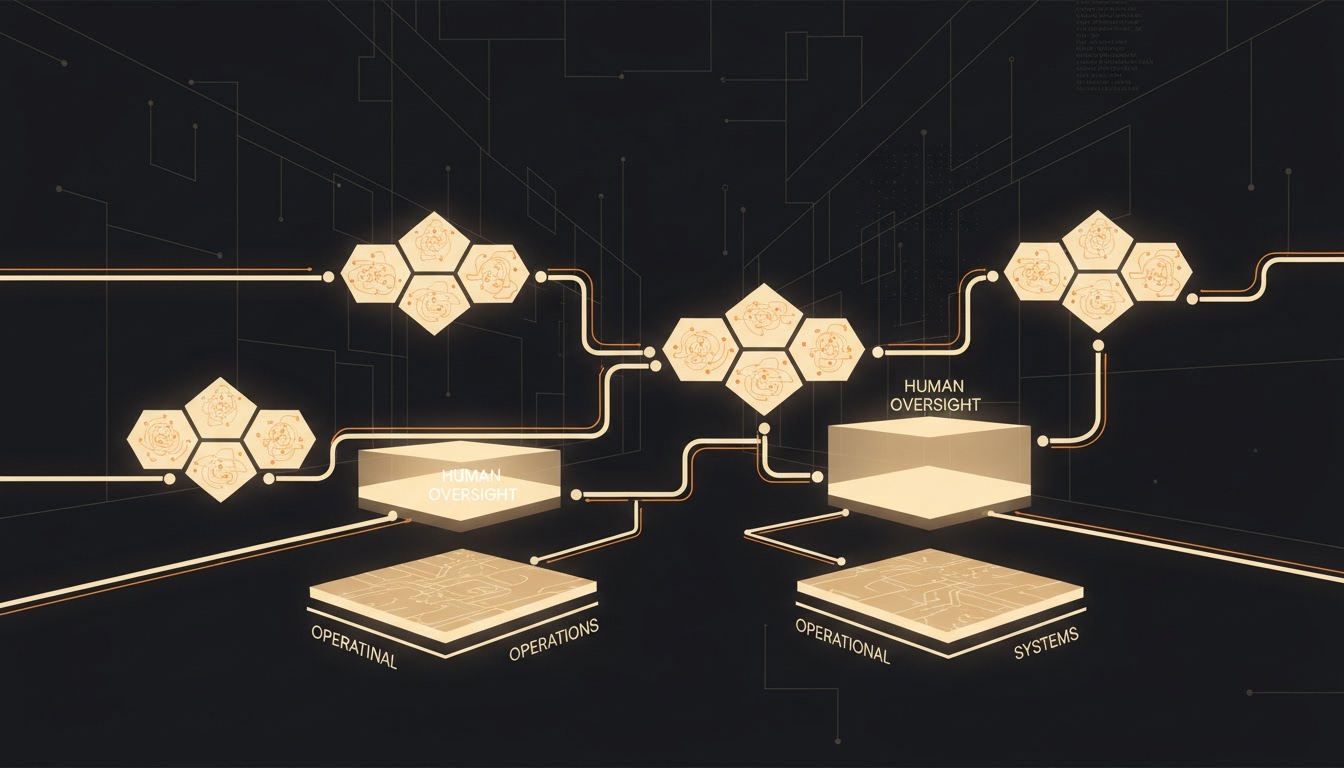
Deploying managed AI agents offers significant opportunities to enhance organizational capacity and streamline complex workflows. However, the integration of these autonomous systems requires a disciplined approach to preserve operational control and mitigate unforeseen risks. This guide provides a pragmatic framework for IT, data, security, and governance leaders to navigate this landscape effectively.
Maintaining operational control means establishing clear boundaries, robust oversight, and defined human intervention points. This article outlines key considerations, drawing on established frameworks, to help leaders design, deploy, and manage AI agents responsibly, ensuring they align with organizational objectives and risk tolerances.
1. Assess Impact and Map Risks Prior to Deployment
To maintain operational control, begin by thoroughly assessing the potential impact and risks associated with each managed AI agent. This involves understanding how the agent will interact with existing workflows, data, and decision-making processes. A structured diagnostic helps identify areas where an AI agent might introduce new vulnerabilities or amplify existing ones.
Leverage frameworks like the National Institute of Standards and Technology (NIST) AI Risk Management Framework (AI RMF), which emphasizes GOVERN and MAP functions to understand, analyze, and document AI risks [1]. Tools such as the Government of Canada's Algorithmic Impact Assessment (AIA) can also guide this process, helping categorize impact levels and identify necessary mitigation measures, even for private sector reuse [2].
- Identify affected stakeholders and critical dependencies.
- Map potential failure modes and their downstream effects.
- Define data access requirements and privacy implications.
- Evaluate compliance with relevant regulations and policies.
2. Establish a Robust AI Governance Framework
Effective governance is paramount for retaining operational control over managed AI agents, distinguishing them from ad-hoc automation. This involves defining clear roles, responsibilities, and accountability structures across the AI agent's lifecycle. Without a formal framework, managing the evolving capabilities and outputs of AI agents can become challenging.
Consider implementing an AI management system that aligns with international standards, such as ISO/IEC 42001, which specifies requirements for establishing, implementing, maintaining, and continually improving such systems [3]. This provides a structured approach to policy development, risk management, performance evaluation, and continuous improvement for all deployed AI agents.
- Define clear ownership for AI agent development and operation.
- Establish policies for data access, usage, and security.
- Create a formal process for AI agent change management.
- Outline audit trails and logging requirements for transparency.
3. Design for Human-in-the-Loop and Review Boundaries
Operational control is best preserved when human oversight is intentionally integrated into AI agent workflows, rather than being an afterthought. This means designing specific human-in-the-loop mechanisms and clear review boundaries for critical decisions or high-risk outputs. Managed AI agents should augment human capacity, not replace critical human judgment entirely.
Define explicit thresholds for human review, such as confidence scores below a certain percentage, unusual data patterns, or decisions impacting sensitive areas. Establish a decision method for human intervention, including who is responsible for review, the expected turnaround time, and the process for overriding or adjusting AI agent outputs. This ensures accountability and mitigates failure modes.
- Identify critical decision points requiring human validation.
- Set clear confidence thresholds for AI agent autonomy.
- Establish escalation paths for ambiguous or high-risk outputs.
- Train human operators on intervention protocols and tools.
4. Implement Continuous Performance Monitoring and Baselines
Maintaining operational control over managed AI agents requires continuous monitoring against predefined performance baselines and service levels. This allows leaders to detect deviations, assess efficacy, and ensure the AI agent continues to operate within expected parameters. Proactive monitoring is crucial for identifying potential degradation or unintended behaviours before they impact operations significantly.
Establish key performance indicators (KPIs) related to accuracy, throughput, latency, and resource consumption. Compare these metrics against initial baselines to track performance over time. Implement automated alerts for significant deviations and regularly review AI agent outputs for quality and adherence to operational objectives, enabling timely adjustments and improvements.
- Define quantitative KPIs for AI agent performance.
- Establish baseline performance metrics before deployment.
- Implement real-time monitoring and alerting systems.
- Conduct regular audits of AI agent outputs and decisions.
5. Plan for Iterative Improvement and Organizational Change
Deploying managed AI agents is not a static event but an iterative process requiring ongoing adaptation and improvement. Operational control is sustained through a commitment to learning from deployment experiences and evolving the AI agent and its surrounding workflows. This includes addressing technical refinements, policy updates, and human-process adjustments.
Anticipate organizational change management needs, as AI agents will alter existing roles and responsibilities. Foster a culture of continuous feedback, allowing operational teams to report issues and suggest enhancements. Regularly reassess the AI agent's impact and efficacy, using insights to refine its design, update governance policies, and ensure its long-term value and responsible operation.
- Establish a feedback loop for operational teams.
- Schedule periodic reviews of AI agent performance and policies.
- Plan for retraining and upskilling human teams.
- Document all changes and their rationales for transparency.
Deploying managed AI agents effectively requires more than just technical implementation; it demands a strategic commitment to operational control. By systematically assessing impact, establishing clear governance, integrating human oversight, and continuously monitoring performance, leaders can ensure these powerful tools enhance organizational capacity responsibly.
This pragmatic checklist provides a foundation for IT, data, security, and governance leaders to navigate AI agent deployment with confidence. Kaza specializes in diagnosing workflows and deploying managed AI agents, offering a structured path to integrate these capabilities while preserving your organization's operational integrity. Consider exploring Kaza's diagnostic approach to identify how managed AI agents can safely augment your team's execution capacity.
Frequently asked questions
How do AI agents differ from simple automation tools in terms of control?
AI agents possess adaptive and often autonomous decision-making capabilities, unlike simple automation that follows predefined rules. This autonomy necessitates more sophisticated control mechanisms, including robust governance frameworks and explicit human review boundaries, to manage their evolving behaviour and potential for unintended outcomes effectively.
What is the role of the Algorithmic Impact Assessment (AIA) in private sector deployment?
While originating from the Government of Canada [2], the AIA provides a structured, open-licence questionnaire to assess the impact level of automated decision systems. Private sector organizations can adapt this tool to systematically identify risks, understand potential societal or operational impacts, and determine appropriate mitigation strategies for their AI agent deployments.
How can ISO/IEC 42001 support operational control without certification?
ISO/IEC 42001 offers a comprehensive framework for establishing an AI management system [3]. Even without formal certification, organizations can adopt its requirements to structure their governance, risk management, and continuous improvement processes for AI agents. This provides a systematic approach to maintaining control and demonstrating responsible AI practices.
What are common failure modes for AI agents that require human review?
Common failure modes include data drift leading to inaccurate outputs, model bias causing unfair decisions, unexpected interactions with new data, or performance degradation over time. Human review is crucial for identifying these issues, validating AI agent outputs in ambiguous situations, and intervening when an agent operates outside its defined parameters or acceptable risk levels.
How does Kaza help organizations maintain operational control?
Kaza diagnoses workflows, designs and deploys managed AI agents within existing tools, and continuously improves them. By focusing on practical execution capacity, Kaza helps organizations implement the structured assessments, governance, and human-in-the-loop designs necessary to maintain robust operational control, ensuring AI agents deliver value responsibly.