Integrating AI agents into an organization demands more than just deployment; it requires a robust operating model that treats these agents as managed operational capacity. This approach ensures they reliably contribute to throughput, service quality, and process reliability, rather than becoming isolated tools or unmanaged risks. Operations leaders must define how agents are owned, maintained, and evolved within the existing organizational structure.
A well-defined operating model clarifies responsibilities for run ownership, establishes routines for ongoing service and performance management, and implements stringent controls for change and release. This framework is essential for mitigating risks, ensuring compliance, and maximizing the sustained value of AI agent deployments. Without it, the promise of AI agents as scalable capacity remains unfulfilled.
Establishing Clear Run Ownership for AI Agents
Effective AI agent operations begin with clear run ownership, assigning accountability for the agent's performance, maintenance, and impact. This ensures that a specific individual or team is responsible for the agent's operational health, just as they would be for any critical system or process. Without this, agents can become 'orphaned,' leading to performance degradation and unaddressed issues.
Run ownership encompasses monitoring agent outputs, managing its lifecycle, and ensuring its alignment with business objectives. This role is distinct from development and focuses on the day-to-day operational integrity and value delivery. It is a critical component of the GOVERN function within the NIST AI RMF, ensuring accountability for trustworthiness throughout the AI lifecycle [1].
- Designate a primary owner for each deployed AI agent.
- Define clear metrics for agent performance and success.
- Establish escalation paths for operational incidents.
- Integrate agent ownership into existing team structures.
Implementing Robust Service Routines for Agent Performance
Maintaining the reliability and effectiveness of AI agents requires structured service routines, much like any other critical operational asset. These routines include proactive monitoring, regular performance reviews, and scheduled maintenance to prevent drift and ensure consistent output quality. Neglecting these routines can lead to agents becoming less effective over time, eroding their value.
Service routines should cover data quality checks, model retraining schedules, and anomaly detection. This proactive management is vital for the MEASURE and MANAGE functions of the NIST AI RMF, enabling continuous assessment and optimization of agent performance [1]. It ensures agents remain aligned with their intended purpose and operational standards.
- Schedule daily or weekly performance monitoring.
- Conduct monthly or quarterly performance reviews.
- Establish protocols for data quality and model drift detection.
- Define incident response procedures for agent failures.
Applying Rigorous Change and Release Controls
Managing changes to AI agents requires controls as stringent as those applied to any production software, to prevent unintended consequences and maintain operational stability. Every modification, whether a model update or a workflow adjustment, must follow a defined process including testing, validation, and controlled deployment. Uncontrolled changes can introduce errors, security vulnerabilities, or compliance risks.
Change and release controls ensure that updates are thoroughly vetted before deployment, minimizing disruption to critical workflows. This includes version control, impact assessments, and rollback plans. These controls are essential for the MANAGE function of the NIST AI RMF, ensuring changes are implemented responsibly and transparently [1].
- Implement version control for all agent components.
- Require testing and validation for every change.
- Establish a formal approval process for deployments.
- Develop rollback plans for failed releases.
Integrating Human Review and Oversight into Agent Workflows
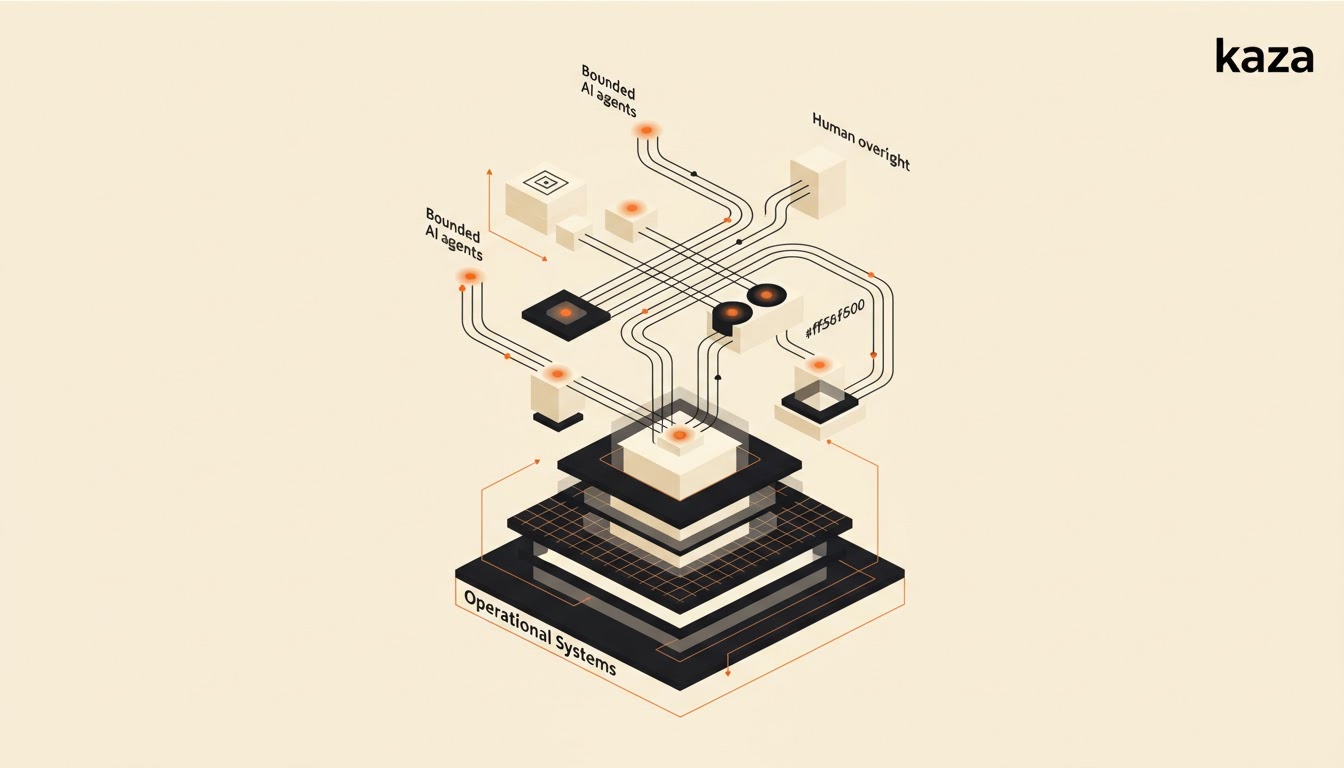
Even the most advanced AI agents require human review and oversight, particularly for tasks involving high-stakes decisions, novel situations, or sensitive data. This integration ensures quality, mitigates risks, and builds trust in the agent's outputs. Relying solely on automation without human checkpoints can lead to errors propagating rapidly and undetected.
Design workflows that clearly define when and how human intervention occurs, whether for validation, exception handling, or final approval. This hybrid approach leverages the efficiency of AI agents while retaining human judgment and accountability. It is a key aspect of the MAP function in the NIST AI RMF, identifying and addressing risks in AI systems [1].
- Define clear thresholds for human intervention.
- Establish feedback loops for human corrections.
- Train staff on agent capabilities and limitations.
- Ensure audit trails for all human-agent interactions.
Choosing the Right AI Agent Delivery Model
The choice of AI agent delivery model—internal build, platform configuration, or managed delivery—significantly impacts the required operating model and organizational overhead. An internal build offers maximum customization but demands substantial internal expertise and resources for development, maintenance, and governance. This model requires the most extensive internal operating model to manage.
Platform configuration uses vendor tools for agent assembly, reducing development burden but still requiring internal operational management for deployment and monitoring. Managed delivery, like Kaza's approach, offloads much of the operational burden to a specialist, providing ready-to-deploy operational capacity with integrated run ownership, service routines, and change controls, simplifying the internal operating model significantly.
- Assess internal AI development and operational expertise.
- Evaluate the complexity and uniqueness of the workflow.
- Consider the long-term maintenance and evolution needs.
- Determine acceptable levels of operational overhead.
The next decision for operations leaders is to select the appropriate AI agent delivery model based on their internal capabilities and workflow complexity. If your organization lacks dedicated AI operational expertise and the workflow demands dynamic adaptation, a managed delivery model is likely the most pragmatic choice.
Conversely, if you possess robust internal AI development and operational teams, and the workflow is relatively stable, an internal build or platform configuration might be considered. The observation that would change this recommendation is a significant shift in internal resource availability or the emergence of a highly standardized, low-complexity workflow suitable for simpler automation.
Frequently asked questions
What is 'run ownership' for an AI agent?
Run ownership designates a specific individual or team accountable for an AI agent's day-to-day operational performance, health, and alignment with business objectives. This includes monitoring outputs, managing incidents, and ensuring its continuous, reliable function within the workflow. It's about operational accountability, not just technical development.
How do service routines differ from development cycles for AI agents?
Service routines focus on the ongoing operational health of a deployed AI agent, including monitoring, performance tuning, and scheduled maintenance to prevent drift. Development cycles, conversely, focus on building, enhancing, or significantly modifying the agent's core capabilities or logic. Service routines ensure the agent continues to perform as intended post-deployment.
Why are change and release controls critical for AI agents?
Change and release controls are critical to manage updates and modifications to AI agents safely and predictably. They prevent unintended errors, maintain workflow stability, and ensure compliance. Without these controls, changes could introduce new risks, degrade performance, or disrupt critical business processes, undermining the agent's reliability.
When should human review be integrated into an AI agent workflow?
Human review should be integrated into AI agent workflows for high-stakes decisions, novel or ambiguous situations, and tasks involving sensitive data. It acts as a critical quality assurance step and a safeguard against unforeseen errors or biases. Defining clear thresholds for human intervention ensures appropriate oversight without impeding efficiency.
What is the primary benefit of a managed AI agent delivery model?
The primary benefit of a managed AI agent delivery model is offloading the significant operational burden of development, deployment, and ongoing management to a specialist. This provides organizations with ready-to-use operational capacity, complete with integrated run ownership, service routines, and change controls, allowing internal teams to focus on core business functions.