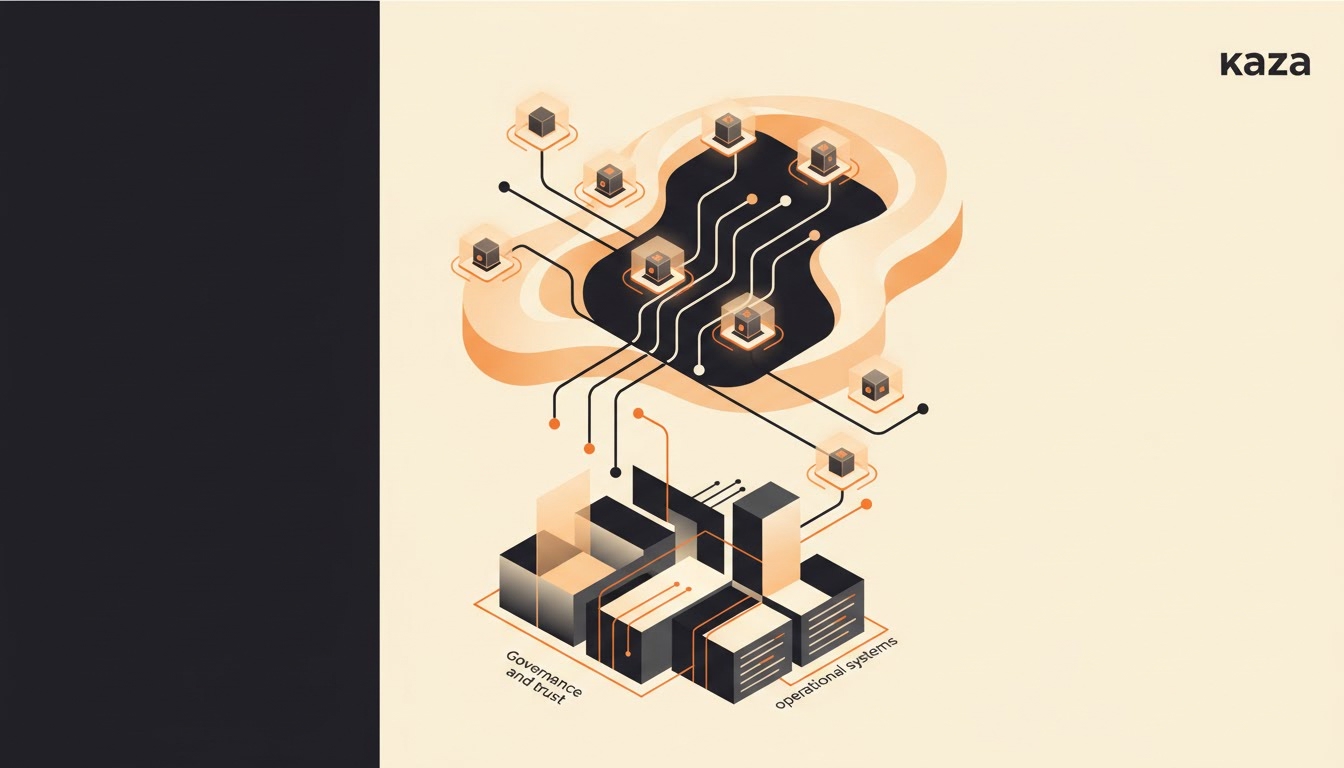
As organizations increasingly deploy managed AI agents to enhance operational capacity, establishing a robust governance framework is paramount. Unlike simpler automations, AI agents exhibit adaptive behaviours, necessitating a distinct approach to oversight that balances innovation with accountability. This article provides a practical framework for leaders to navigate this complexity.
Effective AI agent governance is not merely about compliance; it is about building trust, ensuring safety, and maintaining control over autonomous systems. It requires translating abstract principles into concrete, actionable routines and decision rights, ensuring that AI agents operate within defined ethical and operational boundaries while delivering tangible value.
Defining Governance Layers for AI Agents
Effective AI agent governance requires a layered approach, ensuring oversight at strategic, operational, and technical levels. The strategic layer defines the ethical guidelines, risk appetite, and business objectives for AI agent deployment. This layer sets the overall direction and ensures alignment with organizational values and regulatory expectations, such as those outlined in voluntary frameworks like the NIST AI RMF [1].
The operational layer translates strategic directives into actionable policies and procedures for day-to-day management. This includes defining workflow integration, human review protocols, and incident response. The technical layer focuses on the practical implementation of controls, such as data access permissions, model versioning, and performance monitoring. Each layer requires distinct decision rights and accountability.
- Strategic: Ethical guidelines, risk appetite, business objectives.
- Operational: Policies, human review, incident response.
- Technical: Data access, model versioning, performance monitoring.
Establishing Clear Decision Rights and Accountability
Clarity in decision rights is fundamental for accountable AI agent governance. For managed AI agents, this involves delineating responsibilities between the organization and the service provider, such as Kaza. Key decisions include agent deployment approval, scope changes, data access permissions, and the authority to pause or override agent actions. Ambiguity here can lead to significant operational risks.
Accountability must be tied to specific roles and responsibilities within each governance layer. For instance, the operational lead might have the right to approve a new workflow for an AI agent, while a technical expert is accountable for ensuring its secure data handling. This ensures that every aspect of an AI agent's lifecycle has a designated decision-maker and responsible party, fostering a culture of ownership.
- Define who approves agent deployment and scope changes.
- Assign authority for data access and agent override.
- Ensure clear accountability for each governance layer.
- Delineate responsibilities between internal teams and managed service providers.
Implementing Evidence and Review Cadence
Robust evidence collection and a defined review cadence are critical for maintaining trust and control over AI agents. This includes comprehensive activity logging that captures agent decisions, data inputs, and outputs, alongside any human interventions. Unlike simple automation, adaptive AI agents require logging of model iterations and learning parameters to understand evolving behaviours and potential drift.
A structured review cadence ensures ongoing oversight. This might involve daily operational checks for critical agents, weekly performance reviews, and monthly strategic assessments. These reviews should analyze agent performance against key metrics, identify anomalies, and validate compliance with established policies. Regular human review points are essential, especially for managed AI agents, to ensure alignment with evolving business needs and ethical considerations.
- Comprehensive activity logging for agent decisions and data.
- Log model iterations and learning parameters for adaptive agents.
- Define daily, weekly, and monthly review cadences.
- Regular human review to validate performance and compliance.
Controls for Adaptive AI Agents
AI agents, particularly those with adaptive capabilities, require specific controls beyond those for static automation. These include 'guardrail' controls that prevent agents from operating outside predefined parameters or making decisions with unacceptable risk. For instance, a managed AI agent might have a guardrail preventing it from processing transactions above a certain value without human approval, or from accessing unauthorized data sources.
Version control for AI agent models and configurations is another critical control, allowing for rollbacks and audit trails of changes. Furthermore, 'explainability' controls, which provide insights into an agent's decision-making process, are vital for human review and debugging. These specific controls help manage the inherent variability and potential for emergent behaviour in adaptive AI agents, ensuring precision and safety.
- Guardrail controls to limit agent behaviour and risk.
- Version control for models and configurations.
- Explainability features for decision transparency.
- Mechanisms for human override and intervention.
Navigating Organizational Change and Human Review
Deploying AI agents inherently involves organizational change, requiring careful management of human roles and workflows. The introduction of managed AI agents, such as those deployed by Kaza, shifts human effort from routine execution to oversight, exception handling, and strategic analysis. This transition necessitates clear communication and training to empower employees in their new, augmented roles.
Human review remains indispensable, acting as the ultimate safety net and quality assurance for AI agents. This review is not about re-doing the agent's work, but about validating its outputs, identifying biases, and providing feedback for continuous improvement. Establishing clear human-in-the-loop processes, where agents flag uncertain decisions for human approval, ensures accountability and builds trust in the new operational model.
- Manage organizational change through clear communication.
- Train employees for augmented roles in oversight.
- Integrate human review for validation and feedback.
- Implement human-in-the-loop for uncertain agent decisions.
Establishing a robust AI agent governance framework is not an option but a necessity for organizations leveraging managed AI agents. By defining clear governance layers, assigning precise decision rights, and implementing a rigorous evidence and review cadence, leaders can build trust and maintain control over these powerful tools. This framework ensures that AI agents enhance operational capacity responsibly.
For your next pilot project, use this framework to define the specific governance layers, decision rights, and review cadences required. Start by identifying the agent's impact level and autonomy, then select appropriate controls and human review points. This pragmatic approach will ensure your AI agent deployments are both effective and accountable from the outset.
Frequently asked questions
How does AI agent governance differ from traditional IT governance?
AI agent governance focuses on the adaptive, often opaque nature of AI decisions, requiring specific controls for model drift, bias, and explainability. Traditional IT governance typically addresses system reliability, security, and data integrity for static software. AI agents demand continuous monitoring of their learning and decision processes, alongside standard IT controls.
What is the role of human review in managed AI agent governance?
Human review in managed AI agent governance acts as a critical oversight layer. It validates agent outputs, handles exceptions, and provides feedback for continuous improvement. For managed services like Kaza, human review ensures the agent's actions align with organizational intent and ethical guidelines, preventing unintended consequences and maintaining accountability.
How do we audit the decisions made by an AI agent?
Auditing AI agent decisions requires comprehensive activity logging that captures inputs, outputs, and the specific model version used. For adaptive agents, it also includes logging changes to learning parameters. This evidence allows for retrospective analysis, ensuring transparency and accountability. Explainability tools can further illuminate the agent's decision-making logic for human review.
Can a voluntary framework like NIST AI RMF be legally binding?
No, the NIST AI Risk Management Framework is a voluntary framework designed to help organizations manage AI risks responsibly [1]. While it provides valuable guidance and best practices, it is not legally binding in itself. However, adhering to such frameworks can demonstrate due diligence and contribute to compliance with broader regulatory requirements or industry standards.
What are 'decision rights' in the context of AI agent governance?
Decision rights define who has the authority to make specific choices regarding an AI agent's lifecycle, from deployment to modification and override. This includes approving new workflows, granting data access, or pausing an agent's operation. Clear decision rights prevent ambiguity and ensure accountability, especially when multiple teams or external partners like Kaza are involved.