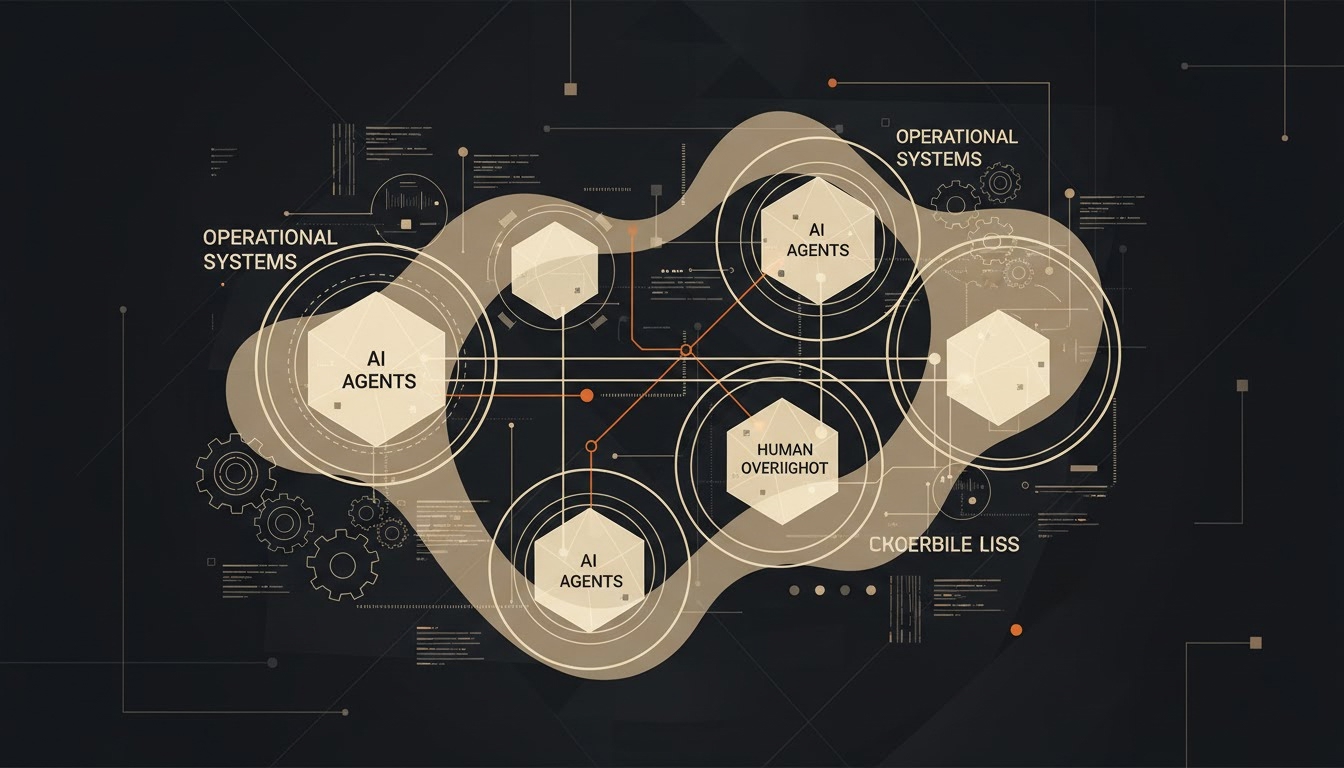
Calculating the Return on Investment (ROI) for managed AI agents requires a comprehensive approach that extends beyond simple cost reduction. Operational leaders must evaluate value through a lens of capacity, quality, service, risk, and total operating cost to capture the full economic impact.
This article provides a pragmatic framework for quantifying AI agent ROI, offering a structured method to assess both direct and indirect benefits. Understanding these elements is crucial for making informed decisions about deploying AI agents within your organization's workflows.
Defining the AI Agent Value Equation
The core of calculating AI agent ROI lies in a comprehensive value equation that captures both tangible and intangible benefits. Operational leaders should define value as the sum of capacity gains, quality improvements, service level impacts, and risk reduction, minus the total operating costs.
This holistic approach ensures that the economic assessment goes beyond simple automation of tasks. It accounts for how managed AI agents contribute to overall operational resilience and strategic objectives, rather than just immediate cost savings.
- Value = (Capacity + Quality + Service + Risk) - Costs
- Capacity: Increased throughput, reduced backlog
- Quality: Error reduction, consistency improvements
- Service: Faster response times, improved reliability
Comprehensive Cost Categorization for AI Agents
Accurately assessing the total cost of ownership for AI agents is critical for a realistic ROI calculation. Costs extend beyond initial deployment to include ongoing operational expenses, data access, human review, and integration with existing systems.
Neglecting any cost category can lead to an inflated ROI projection. Operational leaders must account for infrastructure, licensing, maintenance, security, and the necessary human oversight and governance required for responsible AI deployment.
- Initial setup: Integration, training, data preparation
- Operational: Licensing, infrastructure, maintenance, monitoring
- Human review: Oversight, exception handling, model feedback
- Governance: Compliance, audit, security measures
Quantifying Capacity, Quality, and Service Level Impacts
Capacity gains from AI agents are measured by increased throughput or reduced processing time for specific workflows, allowing human teams to focus on higher-value activities. This translates directly into operational efficiency and the ability to scale without proportional staff increases.
Quality improvements are quantified by reductions in error rates, increased consistency, and adherence to standards, which can decrease rework and improve customer satisfaction. Service level impacts include faster response times, improved reliability, and enhanced predictability of outcomes, directly affecting operational performance metrics.
- Capacity: Measure tasks completed per hour/day, backlog reduction
- Quality: Track error rates, compliance adherence, rework reduction
- Service: Monitor response times, uptime, predictability of outcomes
Assessing Risk Reduction and Total Operating Cost
Managed AI agents can significantly reduce operational risks by minimizing human error, ensuring consistent policy application, and providing auditable trails for compliance. Quantifying risk reduction involves assessing the financial impact of avoided incidents, penalties, or reputational damage.
Total operating cost considers all expenses incurred to run the workflow, both before and after AI agent deployment. The difference, combined with the quantified benefits, provides a clear picture of the economic shift. This includes costs related to human review, which is essential for responsible AI use [1]. The NIST AI Risk Management Framework (AI RMF) emphasizes GOVERN, MAP, MEASURE, and MANAGE functions for trustworthiness [1]. Operational leaders can MEASURE the impact of AI agents on risk reduction by tracking incident rates and compliance adherence.
- Risk: Reduced compliance breaches, fewer operational errors
- Total Operating Cost: Pre- vs. post-deployment expenses
- Human Review: Essential for managing AI agent failure modes
- NIST AI RMF: MEASURE function aids risk assessment [1]
Implementing Sensitivity Analysis for Robust ROI
Sensitivity analysis is crucial for understanding how variations in key assumptions impact the projected ROI of AI agents. Operational leaders should model scenarios where agent efficiency, human review rates, or data quality fluctuate, revealing the robustness of the investment.
This analysis helps identify critical variables and potential failure modes, allowing for proactive risk mitigation strategies. A robust ROI calculation can withstand reasonable changes in underlying assumptions, providing greater confidence in deployment decisions and resource allocation.
- Identify key variables: Agent efficiency, human review time, data accuracy
- Model best-case, worst-case, and most likely scenarios
- Assess impact on projected ROI and payback period
- Inform contingency planning and risk management strategies
Operational leaders must move beyond simple cost-cutting metrics to truly assess the economic value of managed AI agents. By applying a holistic value equation that encompasses capacity, quality, service, risk, and total operating costs, organizations can make data-driven decisions.
Your next decision should be to select a specific workflow for a pilot AI agent deployment. Justify this by demonstrating clear, measurable operational inefficiencies and a high potential for quantifiable gains in capacity or quality. Reconsider if initial data analysis reveals that the workflow lacks sufficient data quality or requires excessive human review that negates efficiency benefits.
Frequently asked questions
How do managed AI agents differ from simple automation in ROI calculation?
Managed AI agents offer adaptive learning and decision-making capabilities, impacting ROI through enhanced workflow resilience and continuous improvement. Simple automation typically provides fixed, task-specific cost savings. Agents can reduce the need for extensive human review over time, a key differentiator in long-term ROI.
What role does human review play in AI agent ROI?
Human review is a critical component, ensuring accuracy, compliance, and ethical operation. While it adds a cost, it mitigates risks and improves agent performance, ultimately contributing to a more sustainable ROI. Over time, effective human feedback can reduce the volume of reviews needed, optimizing this cost.
How can I account for organizational change management costs in ROI?
Organizational change management costs should be included in the 'Total Operating Costs' category. These include training, communication, and support for employees adapting to new workflows. While often overlooked, these investments are vital for successful adoption and realizing the full potential ROI of AI agents.
Is it possible to calculate ROI for AI agents if data access is limited?
Limited data access significantly complicates accurate ROI calculation. It can hinder agent training, performance, and the ability to measure impact. Prioritize establishing secure and compliant data access protocols before deployment. Without sufficient data, ROI projections will be speculative and unreliable.
What is a reasonable payback period to expect for AI agent investments?
A reasonable payback period varies widely by industry, workflow complexity, and the scope of deployment. Early, targeted deployments might see returns within 6-12 months, while larger, more complex integrations could take 18-36 months. Sensitivity analysis is key to setting realistic expectations for your specific context.