Functional leaders frequently grapple with the decision to automate critical workflows. While the upfront investment in new technology or managed AI agents might seem daunting, the often-overlooked costs of maintaining the status quo can be far more detrimental. These hidden expenses erode profitability, hinder growth, and strain operational capacity over time.
This article provides a pragmatic framework to identify and quantify the true economic impact of not automating a workflow. By focusing on tangible operational drags like queues, rework, and missed service levels, organizations can move beyond anecdotal evidence to make data-driven decisions about adopting AI-powered solutions.
Quantifying the Drag of Queues and Delays
The most visible cost of not automating often manifests as queues and delays. These aren't just inconveniences; they represent lost productivity, missed opportunities, and a tangible drag on operational capacity. Each item waiting in a queue delays revenue generation, customer satisfaction, or critical business processes from advancing.
To quantify this, identify average queue lengths, processing times, and the value associated with each completed item or service. Calculate the cumulative impact of delayed processing across a specific period. This will provide a clear baseline for the financial implications of current workflow bottlenecks, highlighting the cost of inaction.
- Average queue length
- Average waiting time
- Value of delayed output
Measuring the Impact of Rework and Errors
Manual workflows are inherently prone to human error, leading to significant rework. This means resources are spent correcting mistakes rather than advancing new work, directly impacting efficiency and quality. The cost of rework includes the time spent identifying errors, making corrections, and any subsequent delays or customer dissatisfaction.
Track the frequency and average time spent on rework for specific tasks within the workflow. Assign a cost to this time, including labour and any associated material or opportunity costs. This metric provides a direct measure of quality issues and resource misallocation, offering a compelling argument for automation's precision.
- Rework frequency
- Average time per rework
- Associated labour cost
- Impact on service quality
The Price of Missed Service Levels and Compliance Risks
Failing to meet service level agreements (SLAs) or regulatory compliance due to manual bottlenecks carries substantial financial and reputational risks. Penalties, customer churn, and legal repercussions can far exceed the cost of automation. Manual processes often struggle with the consistency and speed required for stringent operational demands.
Document instances of missed SLAs, compliance breaches, and their associated direct and indirect costs. Consider potential future risks if the workflow remains unautomated, especially in evolving regulatory environments. Managed AI agents can enforce consistent processes and improve auditability, mitigating these critical business risks.
- SLA penalties
- Customer churn impact
- Compliance fines
- Reputational damage
Understanding Constrained Operational Capacity
Perhaps the most strategic cost of not automating is constrained operational capacity. When key workflows are manual, an organization's ability to scale, innovate, or respond to market changes is severely limited. Human resources are tied up in repetitive tasks, preventing them from focusing on higher-value, strategic initiatives.
Assess how much human operational capacity is dedicated to the workflow and what alternative, higher-value activities could be pursued if this capacity were freed. Quantify the opportunity cost of delayed growth or innovation. Managed AI agents can expand this capacity without proportional increases in human resources, enabling strategic flexibility.
- Human hours on repetitive tasks
- Opportunity cost of delayed projects
- Impact on scalability
- Innovation bottleneck
Connect the measured cost to the right intervention
A high avoidable cost does not prove that an AI agent is the right answer. First test whether a rule, better intake, clear handoff, or capacity already available in a SaaS system resolves the constraint with fewer dependencies and less review.
An agent becomes an option only when real cases combine context, exceptions, and preparation work that remains verifiable. Use the calculated cost to set the acceptable effort ceiling, then request a proposal that specifies included cases, review thresholds, workflow ownership, and what would stop the deployment.
- Compare avoidable cost with the full cost of change.
- Choose the smallest intervention that resolves the constraint.
- Retain the cases and assumptions that justify the decision.
Your next decision is to calculate this worksheet for one high-volume workflow using observed inputs. Move to a solution evaluation only when avoidable cost exceeds the full correction, implementation, and review effort within a conservative range. Reconsider the choice if real cases show that a rule, SaaS workflow, or manual improvement removes the constraint with less risk.
Frequently asked questions
How do I quantify the cost of 'constrained operational capacity'?
Quantify this by estimating the value of strategic projects or growth opportunities that cannot be pursued because human resources are tied up in manual workflows. Also, consider the cost of delaying market entry or innovation due to limited capacity. This reveals the opportunity cost of inaction.
What's the difference between simple automation and managed AI agents?
Simple automation (like RPA) handles repetitive, rule-based tasks efficiently. Managed AI agents, however, can interpret unstructured data, make judgments, and adapt to dynamic situations, offering more sophisticated workflow automation and requiring ongoing governance and human review for optimal performance.
Should I automate a workflow if it only has a small, measurable cost of inaction?
Not necessarily. Prioritize workflows where the quantified cost of inaction is substantial and clearly impacts critical business outcomes. Smaller costs might indicate a workflow that is not a primary candidate for immediate, complex automation, though simple optimizations might still be beneficial.
How does human review fit into AI agent automation?
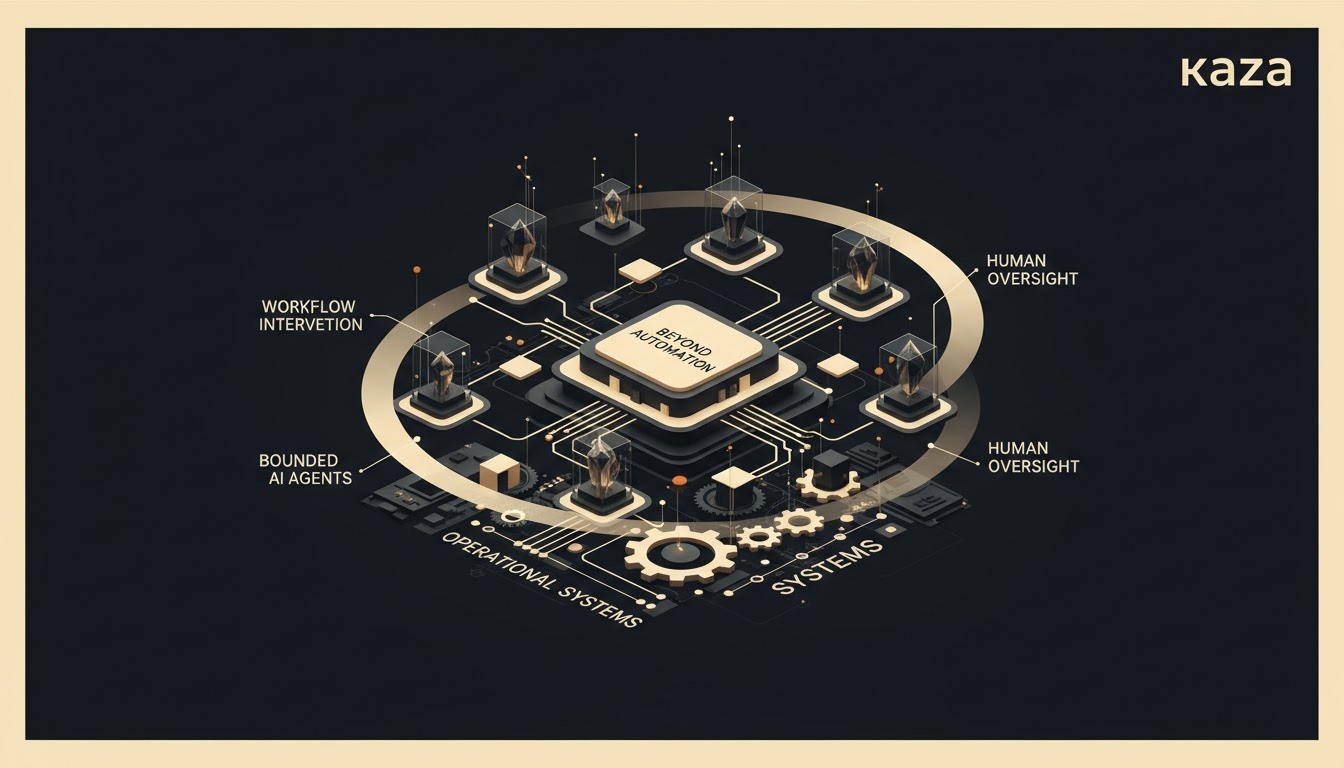
Human review is crucial for managed AI agents, especially for complex or high-stakes decisions. It ensures accuracy, manages exceptions, and provides oversight for continuous improvement and compliance. Kaza designs systems that integrate human review points to maintain quality and trust.
What if my workflow involves sensitive data and compliance requirements?
For workflows with sensitive data, robust governance, data access controls, and security protocols are paramount. Managed AI agents can be deployed within secure environments and configured to adhere to specific compliance frameworks, with human review ensuring adherence to privacy and regulatory standards.