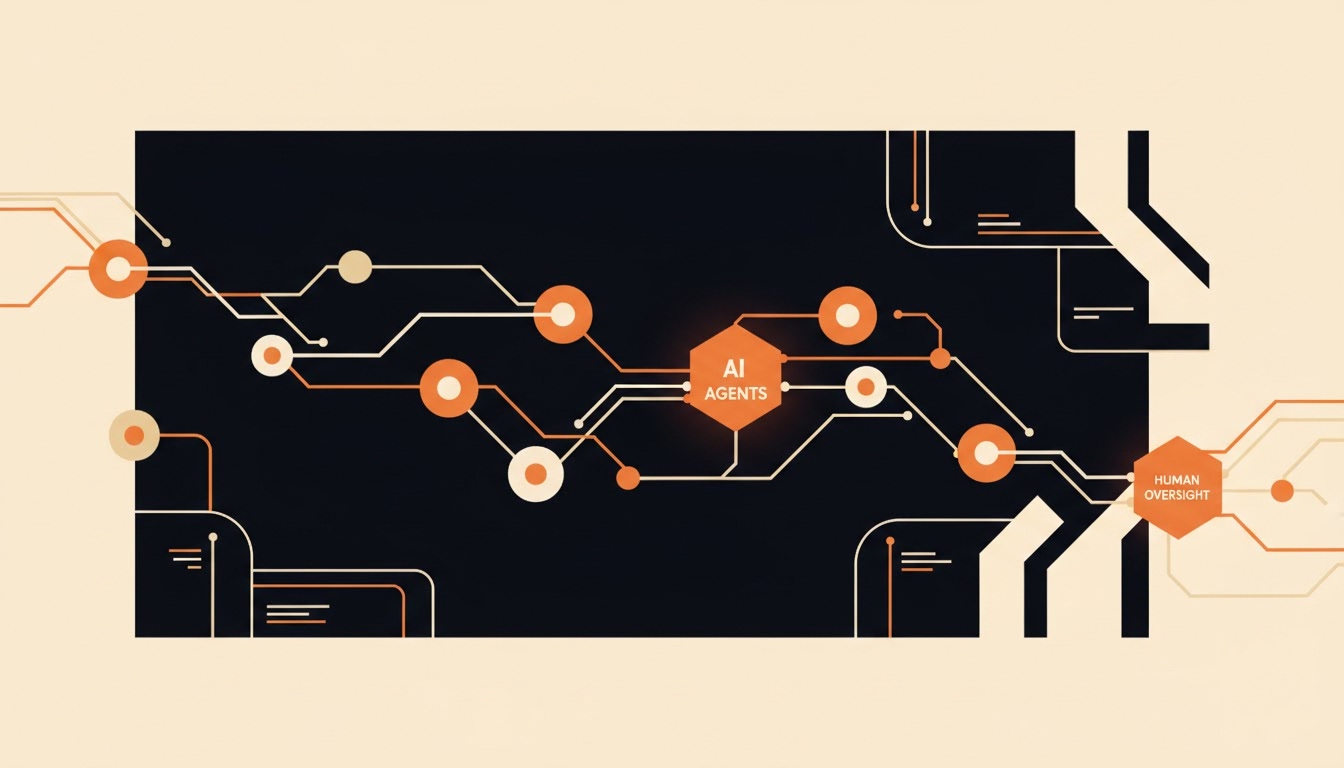
Integrating managed AI agents into existing operations offers significant capacity gains, yet it requires careful workflow diagnosis to ensure responsible deployment. For IT, data, security, and governance leaders, the challenge lies in leveraging these advanced tools while maintaining stringent operational control and adhering to organizational standards.
This guide provides a pragmatic framework for identifying suitable workflows, establishing necessary safeguards, and planning for human oversight. By systematically evaluating tasks and implementing robust governance, organizations can strategically deploy AI agents to enhance efficiency without compromising security or accountability.
Identifying High-Friction Workflows for AI Agent Suitability
To effectively deploy managed AI agents, organizations should first identify workflows characterized by high friction, repetition, and data intensity. These are often processes that consume significant human effort through routine, rule-based tasks or complex data analysis, making them prime candidates for automation and augmentation by AI agents.
Unlike simple automation, AI agents excel where tasks require nuanced data interpretation, dynamic decision-making within defined parameters, and integration across multiple systems. A clear diagnostic approach helps distinguish these opportunities from tasks better suited for traditional automation or those requiring exclusive human judgment.
- Repetitive, high-volume tasks
- Data-rich processes with clear inputs/outputs
- Rule-based decision-making
- Integration across disparate systems
Establishing a Robust Governance Framework
Maintaining operational control during AI agent deployment necessitates a robust governance framework that integrates trustworthiness considerations from design through operation. Adopting voluntary frameworks, such as the National Institute of Standards and Technology (NIST) AI Risk Management Framework (AI RMF), provides a structured approach to this challenge [1].
The NIST AI RMF outlines core functions—GOVERN, MAP, MEASURE, and MANAGE—to help organizations systematically address AI risks and promote responsible use [1]. Additionally, tools like the Government of Canada's Algorithmic Impact Assessment (AIA) can help determine an AI agent's impact level and identify necessary mitigation measures, even for private sector adaptation [2].
- Define clear AI policy and ethical guidelines
- Implement risk assessment and mitigation strategies
- Establish accountability structures for AI agent outputs
- Ensure compliance with data privacy regulations
Designing for Human Oversight and Failure Modes
Effective AI agent deployment requires designing systems that incorporate meaningful human control at appropriate stages, acknowledging potential failure modes. This means establishing clear boundaries where human review is not just an option but a mandatory checkpoint, especially for critical decisions or high-impact outputs.
The UK Government Digital Service recommends maintaining meaningful human control and managing the full AI lifecycle, which includes planning for errors and unexpected outcomes [3]. Organizations must define specific intervention points, escalation protocols, and mechanisms for human override when an AI agent's performance deviates or encounters novel situations.
- Mandatory human review for high-impact decisions
- Clear escalation paths for AI agent anomalies
- Mechanisms for human override and correction
- Regular audits of AI agent decision logs
Implementing Secure Data Access and Integration
Secure data access and seamless integration are foundational to responsible AI agent deployment, ensuring both operational effectiveness and data protection. Organizations must establish stringent access controls, encrypt data in transit and at rest, and adhere to least-privilege principles for all AI agent interactions with sensitive information.
Integrating AI agents into existing tools requires secure Application Programming Interfaces (APIs) and robust authentication protocols. Continuous monitoring of data flows and system interactions is critical to detect and respond to unauthorized access or potential vulnerabilities, safeguarding organizational data integrity.
- Principle of least privilege for data access
- Secure API development and management
- Data encryption in transit and at rest
- Continuous security monitoring and auditing
Continuous Improvement and Organizational Adaptation
Successful AI agent deployment is an iterative process, demanding continuous improvement and organizational adaptation rather than a one-time implementation. Kaza's approach of diagnosing, designing, deploying, and continuously improving ensures that AI agents evolve with organizational needs and emerging challenges.
This ongoing cycle involves regular performance evaluations, feedback loops for AI agent refinement, and upskilling human teams to work alongside these new capabilities. Organizational change management is crucial to foster acceptance, build trust, and integrate AI agents smoothly into daily operations, enhancing overall operational capacity.
- Regular performance evaluation and feedback loops
- Iterative refinement of AI agent models
- Employee training for human-AI collaboration
- Structured change management initiatives
Deploying managed AI agents offers a strategic advantage for organizations seeking to enhance operational capacity and efficiency. By adopting a structured approach to workflow diagnosis, establishing robust governance, and prioritizing human oversight, leaders can integrate these powerful tools responsibly.
This pragmatic framework ensures that AI agents serve as reliable extensions of an organization's capabilities, rather than unmanaged variables. Kaza specializes in diagnosing workflows, designing tailored AI systems, and ensuring their seamless, controlled deployment and continuous improvement within your existing operational landscape.
Frequently asked questions
How do managed AI agents differ from traditional automation or simple chatbots?
Managed AI agents go beyond basic scripting or rule-based chatbots by autonomously performing complex tasks, interpreting nuanced data, and adapting to new information within defined parameters. They integrate across multiple systems and can make more sophisticated decisions, providing practical execution capacity for intricate workflows, unlike isolated automation tools.
What is the primary role of IT leadership in diagnosing workflows for AI agents?
IT leadership is crucial for identifying suitable workflows by assessing technical feasibility, data availability, and integration requirements. They ensure that AI agent deployments align with existing infrastructure, security policies, and data governance standards, acting as a bridge between operational needs and technological capabilities to maintain control.
Can public-sector AI frameworks like NIST AI RMF be applied to private companies?
Yes, frameworks like the NIST AI RMF are voluntary and designed to be broadly applicable, offering guidance for incorporating trustworthiness into AI systems across sectors [1]. Similarly, the Government of Canada's AIA, while federal policy context, is available under an open licence for reuse, providing valuable structure for private organizations [2].
How can an organization ensure data privacy when AI agents access sensitive information?
Ensuring data privacy requires implementing robust access controls based on the principle of least privilege, encrypting all data accessed or processed by AI agents, and conducting regular security audits. Organizations must also comply with relevant privacy regulations and anonymize or de-identify sensitive data wherever possible before agent processing.
What are the key considerations for managing human-AI collaboration effectively?
Effective human-AI collaboration hinges on clear role definition, establishing specific human review points, and providing training for human teams. It means designing AI agents to augment, not replace, human judgment in critical areas, ensuring transparency in AI decision-making, and building trust through consistent, reliable performance and clear communication channels.