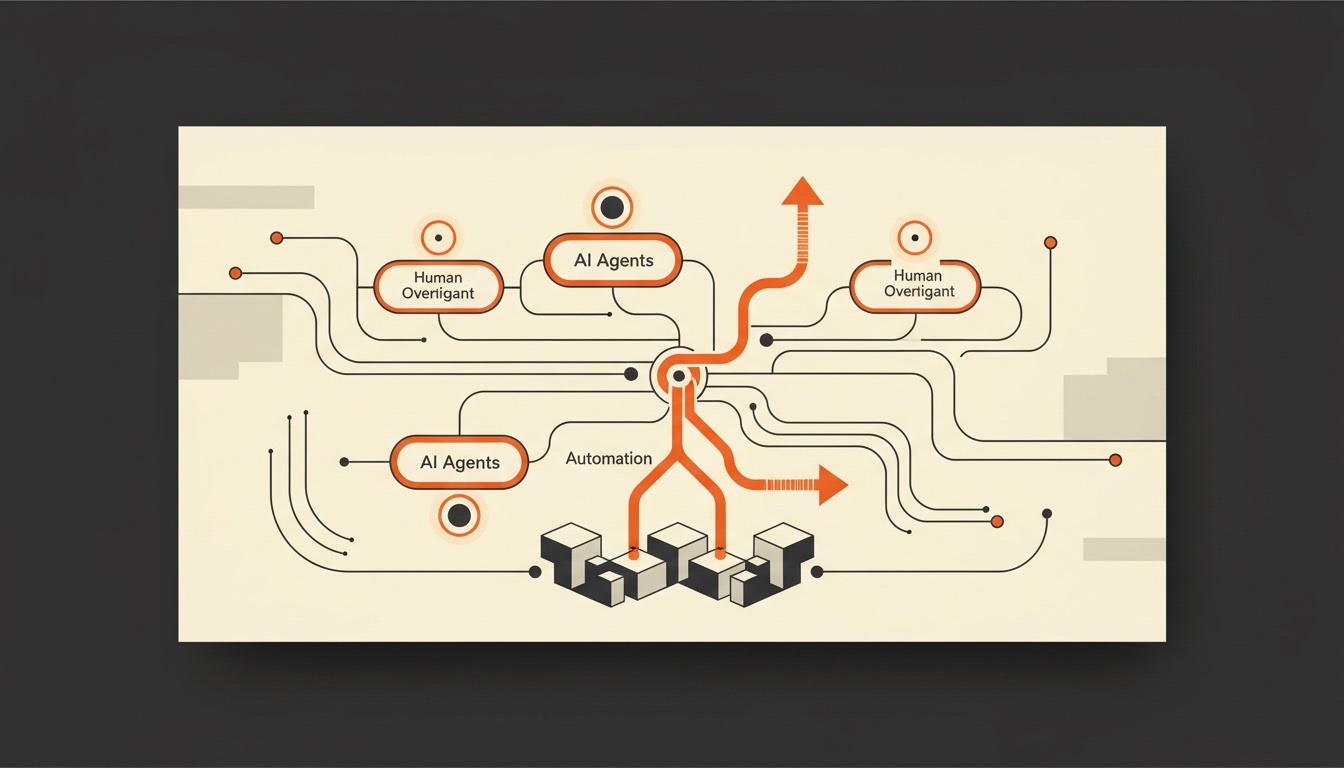
Navigating the landscape of workflow automation options—from Robotic Process Automation (RPA) to SaaS-based solutions and advanced AI agents—requires a clear, pragmatic framework. For IT, data, security, and governance leaders, the core challenge is not just implementing technology, but selecting the right intervention that aligns with organizational capacity and risk tolerance.
This article provides a diagnostic approach to evaluate your workflows, helping you determine whether a process redesign, RPA, a SaaS workflow, or a managed AI agent offers the most effective and responsible path forward. We emphasize choosing the smallest controllable intervention, ensuring operational control and accountability remain paramount.
Understanding the Automation Landscape
The choice among AI agents, RPA, and SaaS workflow automation is fundamentally about matching technology to workflow characteristics. RPA excels at automating highly structured, repetitive tasks with clear rules, often mimicking human interactions with user interfaces. Its strength lies in efficiency gains for predictable processes, such as data entry or report generation across legacy systems.
SaaS workflow automation, conversely, provides pre-built, configurable solutions for common business processes like HR onboarding or expense approvals. These platforms offer standardized workflows with built-in integrations and governance, reducing custom development. AI agents, however, represent a more advanced capability, designed to handle tasks requiring judgment, adaptation, and interaction with dynamic, unstructured data.
- RPA: Best for high-volume, rule-based, repetitive tasks.
- SaaS Workflow: Ideal for standardizing common business processes.
- AI Agents: Suited for dynamic tasks requiring judgment and adaptation.
Variability, Judgment, and the Right Intervention
The most critical factors in selecting an automation solution are workflow variability and the level of human judgment required. If a workflow is highly variable, with frequent changes in inputs or decision paths, an AI agent is often the more suitable choice. For example, an AI agent could triage complex customer support inquiries by understanding intent and sentiment, a task beyond RPA's capabilities.
Conversely, if a workflow is highly stable and follows predictable, explicit rules, RPA or a SaaS solution is generally more appropriate and cost-effective. Attempting to deploy an AI agent for a simple, rule-based task introduces unnecessary complexity and risk. Always seek the smallest controllable intervention that meets the workflow's specific needs, ensuring clear accountability.
- High variability + judgment = AI Agent.
- Low variability + fixed rules = RPA or SaaS.
- Avoid over-engineering with complex solutions for simple problems.
Integration, Exception Management, and Operational Capacity
Integration complexity and exception handling are practical considerations that significantly influence automation choice. RPA often integrates by mimicking human clicks and keystrokes, making it suitable for legacy systems without APIs, but vulnerable to UI changes. SaaS solutions typically offer API-driven integrations, providing more robust connections but limited to pre-built connectors.
AI agents, especially managed AI agents, are designed for more sophisticated integration, often requiring deep access to data sources and context to make informed decisions. They can learn from exceptions and flag novel situations for human review, enhancing operational capacity. However, this requires careful data governance and a clear understanding of failure modes, as outlined in frameworks like the NIST AI Risk Management Framework [1].
- RPA: UI-based integration, sensitive to system changes.
- SaaS: API-driven, pre-built connectors.
- AI Agents: Deep data access, learns from exceptions, requires robust governance.
Accountability, Governance, and Human Oversight
Regardless of the automation chosen, accountability for outcomes always remains with the organization. For AI agents, this is particularly crucial. While an AI agent might be built internally, configured on a platform, or delivered as a managed service by Kaza, the responsibility for its performance, ethical implications, and compliance rests with the deploying entity. This necessitates robust governance frameworks.
Implementing meaningful human control at appropriate stages is vital, as recommended by the UK Government's AI Playbook [3]. Tools like the Government of Canada's Algorithmic Impact Assessment [2] can help identify potential risks and mitigation measures for automated decision systems. This ensures that even with advanced automation, human review and oversight are integrated into the workflow, maintaining trust and control.
- Organizational accountability is non-transferable for all automation.
- Integrate human control points, especially for AI agents.
- Utilize impact assessment tools to identify and mitigate risks.
- Managed AI agents require clear evidence, control, and retained accountability.
Making the Right Choice: A Practical Framework
To make an informed decision, begin by thoroughly diagnosing the workflow. Quantify its variability, identify decision points requiring judgment, map existing integrations, and analyze exception volumes. This granular understanding will guide you toward the most appropriate solution, whether it's a simple process refinement or a complex AI agent deployment. Prioritize solutions that offer transparency and auditability.
Consider your internal capacity for development, integration, and ongoing maintenance. Managed AI agents, like those deployed by Kaza, offer a differentiated option for organizations with constrained cross-functional delivery capacity, providing expert design, deployment, and continuous improvement while ensuring your team retains control and accountability. The goal is to enhance operational capacity safely and effectively.
- Diagnose workflow variability, judgment, integration, and exceptions.
- Match solution to internal capacity and risk appetite.
- Managed AI agents offer expertise for constrained internal resources.
- Ensure transparency and auditability in all automation choices.
Selecting the optimal automation solution—be it process redesign, RPA, SaaS workflow automation, or a managed AI agent—is a strategic decision for IT, data, security, and governance leaders. By systematically evaluating workflows based on variability, judgment, integration, and exception handling, organizations can make choices that enhance operational capacity responsibly and effectively.
The goal is to implement the smallest controllable intervention that aligns with your specific workflow needs and organizational capacity. For those seeking to deploy advanced AI agents with precision and accountability, exploring Kaza's diagnostic approach can provide the structured guidance and expert delivery required to make informed decisions and achieve tangible results.
Frequently asked questions
How do I determine if my workflow needs an AI agent versus RPA?
If your workflow involves dynamic inputs, requires interpretation, or needs to adapt to changing conditions, an AI agent is likely suitable. If it's highly structured, repetitive, and follows fixed rules without deviation, RPA is a better fit. Assess the level of human-like judgment required.
Can a managed AI agent reduce my team's accountability?
No, organizational accountability for the outcomes of any automated system, including managed AI agents, always remains with your organization. Managed services like Kaza provide the expertise for design, deployment, and improvement, but your team retains critical oversight, control, and ultimate responsibility for the agent's actions and compliance.
What are the key governance considerations for deploying AI agents?
Key governance considerations include establishing clear human oversight, defining ethical guidelines, conducting impact assessments (like Canada's AIA [2]), managing data access securely, and planning for failure modes. A robust framework, such as the NIST AI RMF [1], helps incorporate trustworthiness throughout the AI system lifecycle.
When is process redesign a better option than automation?
Process redesign is often superior when the workflow itself is inefficient, poorly defined, or generates excessive exceptions. Automating a broken process only amplifies its flaws. Prioritize redesign when the core problem is lack of clarity, standardization, or human error, before considering any technological automation.
How does Kaza ensure safe deployment of AI agents?
Kaza diagnoses workflows, designs systems tailored to specific needs, and deploys them into existing tools, emphasizing continuous improvement. This process includes integrating human review, adhering to governance best practices, and ensuring clients retain control and accountability. Kaza focuses on pragmatic, responsible deployment without hype.